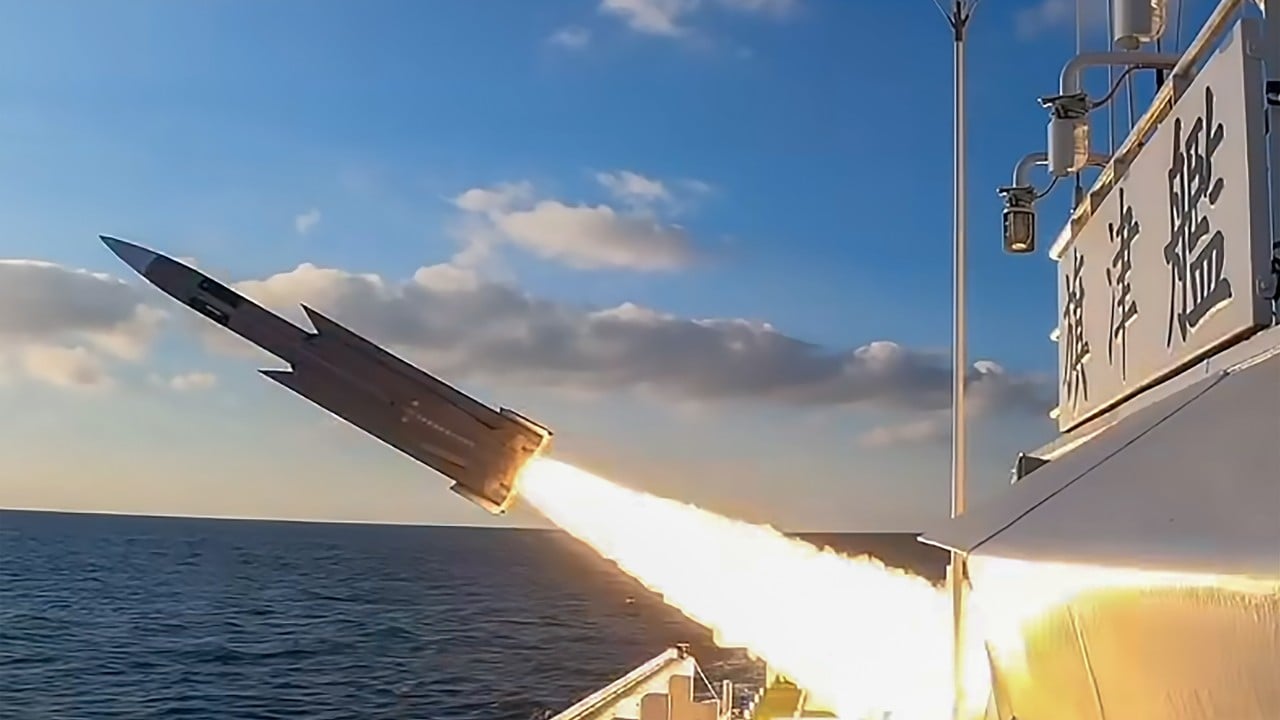
When a coast guard vessel fires a supersonic anti-ship missile during a live-fire drill, the rules of modern naval warfare shift instantly. Taiwan is quietly tearing up the old playbook. For decades, coast guards existed for one purpose: chasing smugglers, policing fisheries, and handling routine maritime law enforcement. Taipei sees things differently now. By engineering its Anping-class catamaran patrol ships with modular missile launch architectures, Taiwan is turning its constabulary fleet into an emergency wartime extension of its navy.
This isn't a theoretical concept discussed in academic white papers. During recent joint precision-missile exercises at Pingtung's Jioupeng Base, the Anping-class patrol ship Qijin successfully fired a heavy anti-ship missile, hitting its mark and proving that peacetime patrol boats can morph into combatants under pressure. If you look closely at how modern asymmetric defense strategies operate, this blurring of lines between civilian maritime agencies and traditional naval forces is becoming a defining trend in the Taiwan Strait.
The Logic Behind Dual-Use Maritime Fleets
Why would a military blur the line between coast guard cutters and warships? Simple math and survival tactics. Traditional navies are prime targets. In a major conflict, standard warships face heavy saturation from adversary air power, submarine fleets, and land-based missile batteries. If an island democracy relies solely on its conventional frigates and corvettes, its target profile is predictable and relatively easy to manage for a larger aggressor.
Enter the dual-use patrol vessel. These ships look like standard law enforcement assets during normal operations. They patrol grey zones, respond to coast guard incursions, and maintain a non-provocative posture day-to-day. Yet beneath their civilian-facing exterior lies the hard infrastructure required to accept naval fire control systems and missile launchers in a crisis.
- Expanded Launch Vectors: Instead of a handful of navy corvettes carrying the entire anti-ship burden, dozens of disguised or auxiliary hulls can suddenly enter the kill chain.
- Target Saturation: Adversary intelligence assets face a nightmare scenario trying to filter out which approaching radar signature is a routine coast guard cutter and which one carries heavy ordnance.
- Resource Optimization: Building dedicated warships is expensive and time-consuming. Upgrading standard patrol hulls with modular missile-mounting points stretches defense budgets much further.
How the Anping Class Changes the Equation
The vessels driving this strategy are the 600-ton Anping-class catamarans, heavily modeled after the Taiwan Navy's agile Tuo Chiang-class fast attack corvettes. These catamarans offer exceptional speed, shallow-water maneuverability, and a stable platform for high-tech gear.
The structural brilliance of the design is the open space at the stern. Engineers built these ships with pre-wired architecture and launch control compatibility that links directly with the navy's combat management systems. When live-fire exercises commence or emergency mobilization orders drop, technicians can integrate launch rails and fire control computers with remarkable speed.
During the recent tri-service drills overseen by President William Lai, this integration went far beyond simple missile tests. Uncrewed aerial vehicles, loitering munitions like the ALTIUS and switchblade systems, and land-based Hsiung Feng III supersonic missiles operated in a synchronized kill chain alongside coast guard assets. The goal is to build an interconnected web where every available sensor and platform feeds targeting data instantly to whoever has a clear shot.
Facing the Reality of Grey-Zone Pressure
Beijing hasn't ignored these adjustments. Chinese coast guard vessels and military drones routinely test Taiwan's response times around outer islands like Kinmen, Matsu, and the waters off Taitung. These grey-zone tactics are designed to exhaust personnel, deplete resources, and normalize a continuous state of intimidation.
By upgrading coast guard capabilities—such as the recent commissioning of the final Anping-class vessel, the Donggang, alongside planned boosts for patrol frigates and specialized equipment—Taipei is signaling that its maritime law enforcement arm will not be a soft target. If an adversary attempts to swarm Taiwanese waters using heavily armed coast guard hulls of their own, Taiwan's equivalent units will be backed by genuine tactical teeth.
You have to look at the broader picture to understand why this matters. Modern defense isn't about having the biggest fleet on paper. It's about resilience, redundancy, and making the cost of aggression too high to calculate. Taiwan's decision to weld naval strike power onto ordinary patrol boats proves that when survival is on the line, traditional bureaucratic boundaries between agencies simply disappear.
Check out this Taiwan Coast Guard missile drill overview to see how these patrol ships integrate missile launch systems. This video highlights how Taiwan's Anping-class catamaran patrol vessels can be rapidly equipped with anti-ship missile architecture during a conflict.