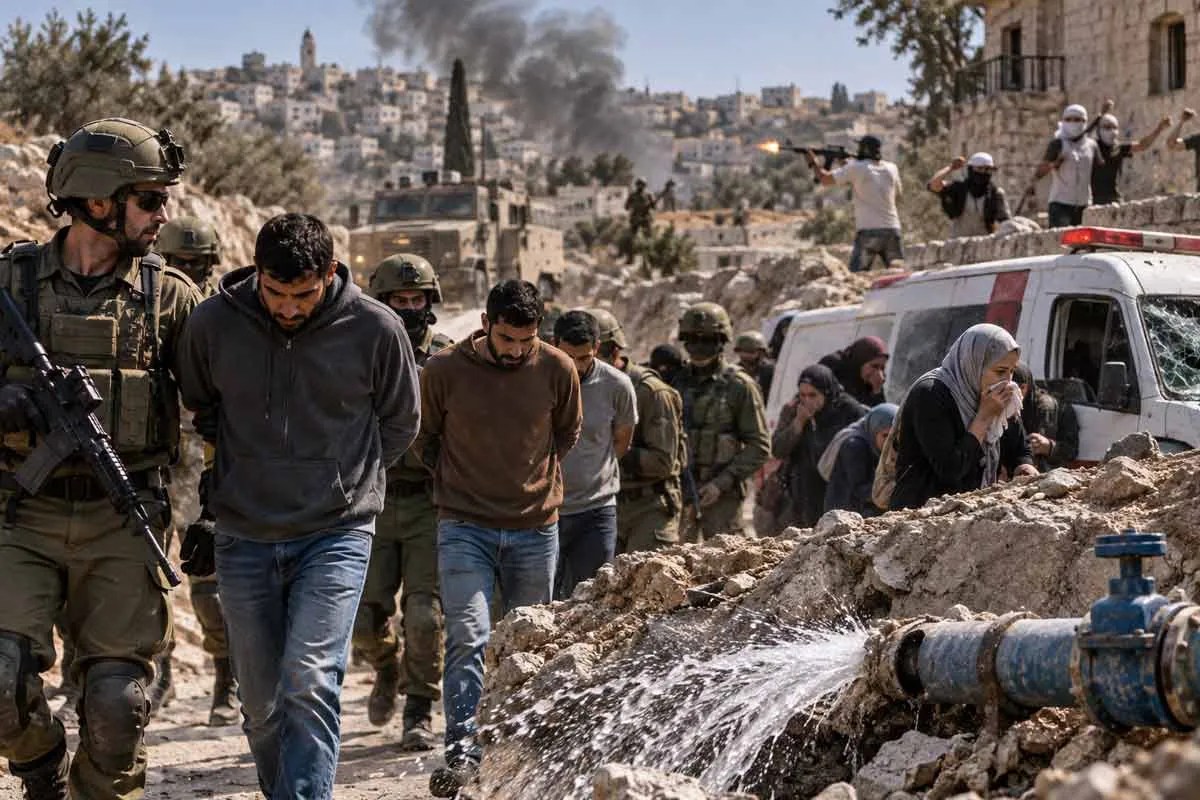
You won't hear about most of it on standard evening broadcasts, but daily life in the occupied West Bank has transformed into an unrelenting pressure cooker. Recent field documentation from bodies like the Palestinian Colonization and Wall Resistance Commission highlights a grim reality: water lines are being cut, homes are sprayed with gunfire, and rural communities are systematically choked out.
When reports surface about hundreds of people suddenly losing their piped water access—such as the incident affecting roughly 700 residents in areas like Ad-Duqaiqa near Hebron—it's easy to dismiss it as a localized infrastructure failure. It isn't. It's part of an escalating campaign of coercion and resource denial.
The Weaponization of Water and Basic Infrastructure
Water scarcity in the West Bank has never been a simple matter of low rainfall or climate anomalies. It's structural, political, and increasingly physical. Over the past year, human rights monitors and local engineers have tracked hundreds of targeted attacks specifically hitting water wells, agricultural cisterns, and supply pipelines.
When groups of armed settlers move into rural areas, breaking solar panels, smashing storage tanks, and slicing through polyethylene water mains, the objective is transparent. Without water for livestock or crops, generational farming communities cannot survive.
- Main pipelines serving hundreds of villagers are deliberately severed overnight.
- Livestock, including hundreds of sheep, are routinely seized during targeted raids.
- Agricultural outbuildings and olive harvests are burned or stolen before families can secure them.
Organizations like the United Nations Office for the Coordination of Humanitarian Affairs (OCHA) have repeatedly noted that these aren't random acts of vandalism. They fit a broader pattern of displacement. Families wake up to find their livelihood gone, forcing difficult choices between staying under constant threat or packing up what remains.
Night Raids and the Reality on the Ground
Beyond the destruction of water networks, towns across Nablus, Ramallah, and Hebron experience frequent military and settler incursions. Entrances and exits get sealed off overnight. Soldiers patrol narrow neighborhood streets while residents stay locked indoors, listening to the sounds of breaking glass and gunfire echoing off stone walls.
In villages like Al-Mughayyir, reports of live ammunition fired toward residential homes and ambulances pepper-sprayed during evening raids have become routine. It’s a grinding environment that wears people down mentally and physically. When international figures or local human rights defenders point out that these actions cross legal and humanitarian lines, the response on the ground rarely changes.
What This Means for the Region Moving Forward
The convergence of military closures, unchecked settler expansion, and the systematic cutting of vital resources creates an unsustainable horizon. Independent reports from international bodies continue to log thousands of violent incidents annually, pointing toward a deliberate strategy of land appropriation.
If you're trying to understand why entire herding communities in the South Hebron Hills or the Jordan Valley are vanishing from maps, look directly at the taps and the pastures. Depriving communities of water is an effective tool of displacement. Until accountability measures shift from paper statements to actual enforcement, the crisis across the West Bank will only deepen.