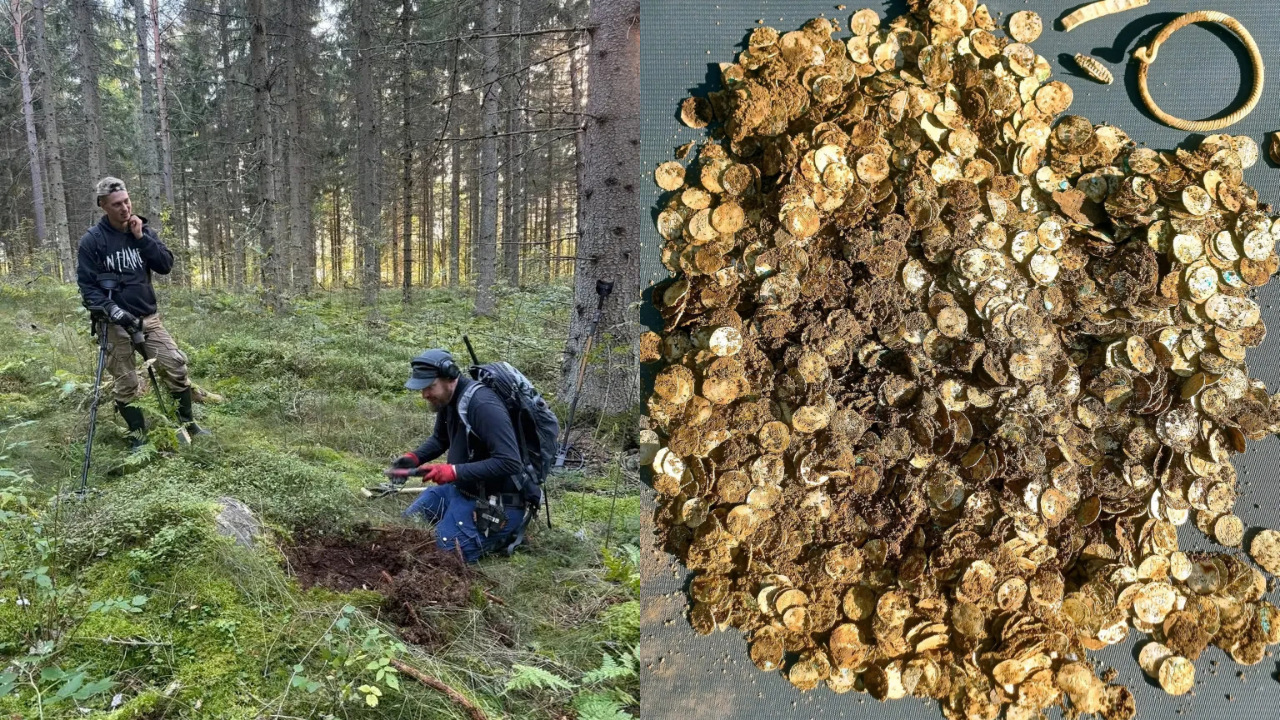
Buried beneath Finnish soil for a thousand years, a massive fortune sat quietly waiting. Kalle Lappinen walked fields near the village of Sysmä on September 3, 2026, swinging his metal detector like countless hobbyists do every weekend. He had no idea he was about to smash historical records. His machine hit a signal that turned into Finland’s largest known Viking Age silver coin hoard, rewriting what experts understand about medieval trade and local wealth.
Let's look at the raw numbers. Lappinen unearthed more than 4,000 Viking Age silver coins weighing roughly 4.5 kilograms, nearly 10 pounds of solid monetary history. But weight and coin counts aren't even the weirdest part of this discovery. Archaeologists from Lahti Museums, led by excavation specialists like Esko Tikkala, discovered that the treasure was split into two separate birch-bark containers buried about 12 metres, or 39 feet, apart. Experts are calling this strange layout a double hoard. Why divide a stash across thirty-nine feet of dirt? Nobody knows for sure, but it opens up massive questions about ancient security habits, merchant behaviors, and emergency stashes.
The Mystery of the Double Hoard
Most hoards found across Northern Europe share a simple logic: a frightened merchant or wealthy landowner digs a single hole, drops a sack of valuables, covers it up, and hopes for the best. Sysmä breaks that rule entirely.
When Frida Ehrnsten, keeper of numismatic collections at the National Museum of Finland, analyzed the layout, the structural oddity stood out immediately. Burying two containers nearly forty feet apart suggests calculated risk management or two separate deposits made by the same person over time. Did a merchant stash half his liquid assets, walk a few paces away, and decide to hide a secondary emergency fund? Did two people contribute to the stash? Or was it a psychological trick to ensure that if a thief stumbled upon one container, the other would remain safe?
Archaeologists found the birch-bark vessels buried about 45 centimeters deep among stones. Placing fragile organic containers under rocks requires deliberate effort. Bark rots over centuries, yet fragments survived long enough to preserve the silver in remarkably good condition.
Where Did the Silver Come From
If you think Viking Age Finland was isolated, look at the coins. This hoard is a literal medieval passport stamps collection. Researchers have identified currency originating from modern-day Sweden, Britain, and Germany. Even more fascinating are the Islamic dirhams minted in regions corresponding to present-day Turkey and Iran.
Silver didn't just stay in local circulation. It flowed across thousands of miles through complex trade networks, river systems, and violent exchanges. A merchant or chieftain sitting in Sysmä a thousand years ago had direct economic ties stretching from the Baltic Sea to the Middle East. These coins carry stamps, inscriptions, and designs that let numismatists trace exact minting locations. Every single piece is a data point mapping out ancient global trade routes long before commercial shipping lanes were formalized.
The collection isn't just coins, either. Alongside the 4,000+ pieces of currency, excavators recovered hack silver, a distinct silver bracelet, a metallic mount, and an individual bead. Hack silver proves that people regularly chopped up coins and jewelry to use as weight-based currency when standard coin values failed or when transactions required exact fractional amounts. It's raw purchasing power in its most brutal, practical form.
Why Sysmä Matters Now
Before this find, Finland's biggest Viking Age coin discovery belonged to Nousiainen, where roughly 1,700 coins were pulled from the earth back in 1895. Sysmä has completely obliterated that benchmark, more than doubling the previous record count.
Sysmä is often viewed today as a quiet rural community, but history tells a different story. Archaeologists point out that the sheer density of silver proves this location was a high-value hub during the Late Iron Age. Trade routes crossed here, wealth accumulated here, and people with serious purchasing power operated here. When you dig up ten pounds of silver, you aren't looking at the spare change of a humble farmer. You are looking at elite capital.
Think about the sheer value of 4.5 kilograms of silver in the eleventh century. This wasn't pocket money used to buy bread. This represented ships, armies, land, or trade fleets. Whoever buried it had serious skin in the game.
The Owner Who Never Returned
Every treasure hoard hides a tragedy or an emergency. The owner of the Sysmä silver never came back for it.
Historians usually point to two main scenarios for hoards dated between AD 1000 and 1050. The first is mercantile storage: a traveling trader buried wealth to travel light through dangerous territory, planning to retrieve it on the return trip. The second is conflict: an invading force, local skirmish, or sudden threat forced residents to scatter into the woods and bury whatever they could carry before fleeing.
If the owner was killed, captured, or driven away permanently, the secret died with them. The silver sat undisturbed while kingdoms rose, languages shifted, and modern civilization grew up all around the burial site.
What Happens Next to the Hoard
Finding the coins is only step one. Conservation is a massive, meticulous grind. Restorers have to clean centuries of corrosion off delicate silver without destroying mint marks, inscriptions, or structural integrity. Every coin must be catalogued, photographed, and cross-referenced against international numismatic databases.
Researchers will spend years publishing papers on these specific pieces. They want to pin down exact mint dates, trace the purity of the silver, and figure out if the two birch-bark containers were filled at the exact same time or years apart.
If you're tracking amateur metal detecting laws or archaeological discoveries in Europe, keep your eyes on Lahti Museums. This find proves that fields across Northern Europe still hold massive historical secrets just beneath the topsoil. You don't need a time machine to rewrite history books; sometimes you just need a sharp eye, a beep in your headphones, and a lot of patience in the dirt.