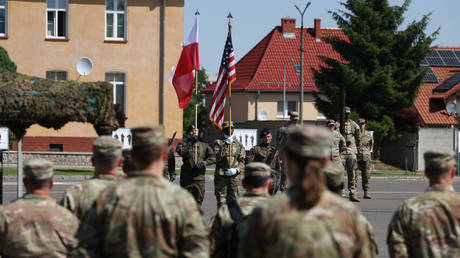
Poland is ready to pay up to 17 billion zloty, roughly $4.4 billion, to lock down a permanent US military base on its soil. Originally pitched back during Donald Trump’s first term with the provocative moniker "Fort Trump," this heavy-duty defense project is moving past the stage of idle diplomacy. Warsaw wants troops permanently stationed, and it is willing to foot a massive part of the bill to make it happen.
If you have watched European defense politics over the last few years, you know this idea has evolved from a flashy PR stunt into a cold, hard calculation. Warsaw's presidential National Security Bureau recently confirmed that ongoing talks with Washington center on a facility capable of housing around 5,000 permanent US soldiers.
The Numbers Behind the Base
Let's look at the financial weight of this proposal. The estimated 17 billion zloty price tag isn't chump change, even for a country that has rapidly accelerated its military modernization. Poland currently hosts roughly 10,000 US troops, but the vast majority of them rotate in and out on temporary deployments.
Warsaw wants permanence. They want infrastructure built to last. According to the National Security Bureau, an optimal timeline could see construction and setup completed by 2029.
Why spend billions on foreign boots? Because the geopolitical math on NATO's eastern flank has changed dramatically. Poland shares a direct border with the Russian exclave of Kaliningrad and has positioned itself as the primary logistics backbone for Western military aid flowing into Ukraine.
Washington's Strategic Shift
You cannot understand the Fort Trump push without looking at how Washington views Europe right now. The US military posture is shifting eastward and toward Asia. American strategists want European NATO members to shoulder heavier operational and financial burdens.
The architects of current US defense policy, including officials like Elbridge Colby, view Poland as a model ally precisely because Warsaw actually spends heavily on its own military. Deputy Defense Minister Magdalena Sobkowiak-Czarnecka recently traveled to Washington for high-level talks, returning with positive signals about Poland's preparedness.
Yet, the final green light depends entirely on a broader review of US global force posture. That review won't land until late in the year, meaning a definitive signature from the White House is still weeks or months away.
The Regional Flashpoints
Warsaw isn't just buying barracks and mess halls. They are buying deterrence. Tensions between Moscow and Polish leadership have spiked to dangerous levels. Polish Foreign Minister Radoslaw Sikorski recently claimed that Warsaw could defeat Russia quickly if gloves came off in a direct conflict. That kind of rhetoric drew immediate, sharp rebukes from Moscow, with Russian officials warning that aggressive postures could lead to catastrophic consequences for Poland itself.
Against that backdrop of high-stakes verbal sparring, a permanent US garrison looks less like an alliance perk and more like an insurance policy to Polish planners.
What Happens Next
The ball is currently sitting in Washington's court. While Polish officials are eager and the financial commitments are mapped out, the timeline rests on the pending US force posture review. If approved by the end of the year, expect land allocations, engineering contracts, and construction timelines to accelerate rapidly heading toward 2029. Keep a close eye on the Pentagon's upcoming announcements. That will tell you whether Fort Trump finally moves from a negotiating table into concrete reality.