You try to fix a bumpy rural road with leftover concrete, and you end up facing a criminal manslaughter charge. That is the grim reality facing a driver named Xie in central China's Henan province. People throw around the phrase that the road to hell is paved with good intentions, but rarely does it manifest with such devastating, legal finality.
Let us look at what actually happened on that dirt track.
The Roadway Fix That Turned Fatal
Xie drove a concrete mixer truck. While navigating a local village path, he noticed severe potholes jarring his vehicle. Instead of driving past and ignoring the municipal headache, he decided to help. He had leftover concrete mix in his drum, so he stopped and patched the rough patches himself.
So far, nobody is calling the police. The trouble started when he tried to protect his wet patch.
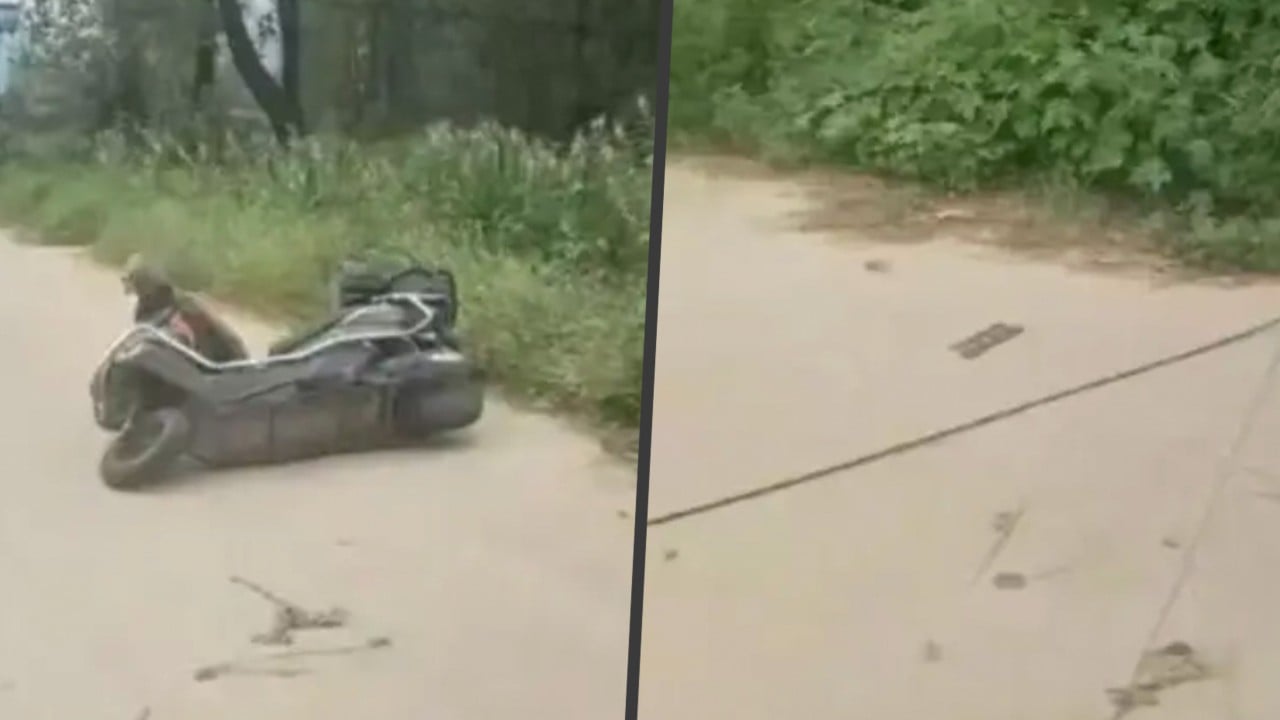
He tied a dark cable between two trees across the narrow road. He wanted a warning barrier. What he built was an invisible clothesline of death.
The finger-thick cable hung roughly one metre above the ground, positioned right at the end of a downhill slope. Even in broad daylight, it was nearly invisible. At night or during a fast ride, it was a trap.
Early on August 10, a 45-year-old villager named Wu Xia rode her electric bicycle down that exact path. She was heading home from the morning town market, supporting three children on a modest monthly income of 4,000 yuan from odd jobs and farming. She never saw the cable. It caught her throat, strangling her instantly. Her secondary school son, riding about ten minutes behind her, found her suffocating on the dirt. Hospital attempts failed. She died just a kilometre from home.
The Legal and Moral Aftermath
On September 11, authorities in Henan formally arrested Xie for manslaughter. Under Chinese criminal law, causing death through negligence typically carries a prison sentence between three and seven years.
Public reaction split sharply. Many online observers mourned the cruel irony. Others pointed out the staggering lack of common sense involved in stringing a dark, unlit wire across a public route.
Xie tried to do the right thing. He didn't maliciously set a trap to hurt someone. He even paid tens of thousands of yuan in funeral expenses to the grieving family. But legal systems do not acquit people of criminal negligence simply because their heart was in the right place.
Ignorance and poor risk assessment often cause more damage than outright malice. If you block or alter a public right-of-way, standard traffic safety rules do not vanish just because you are doing volunteer maintenance. A dark cable without reflective markers or bright warning flags is an obstruction, not a sign.
Safety Lessons From a Tragedy
We like to think that kindness is simple. It is not. Real safety requires foresight, not just emotion.
- Never string unlit, low-visibility barriers across active pathways.
- Use high-visibility fluorescent materials, flashing lights, or physical traffic cones if you must block a hazard.
- Report infrastructure damage to local authorities instead of taking unauthorized DIY engineering risks on public roads.
Good deeds require proper execution. Without caution, compassion turns catastrophic.


:max_bytes(150000):strip_icc()/copenhagen-dk-COPENHAGENTG0721-4a481cb6025b43d1a781b1571b144f46.jpg)