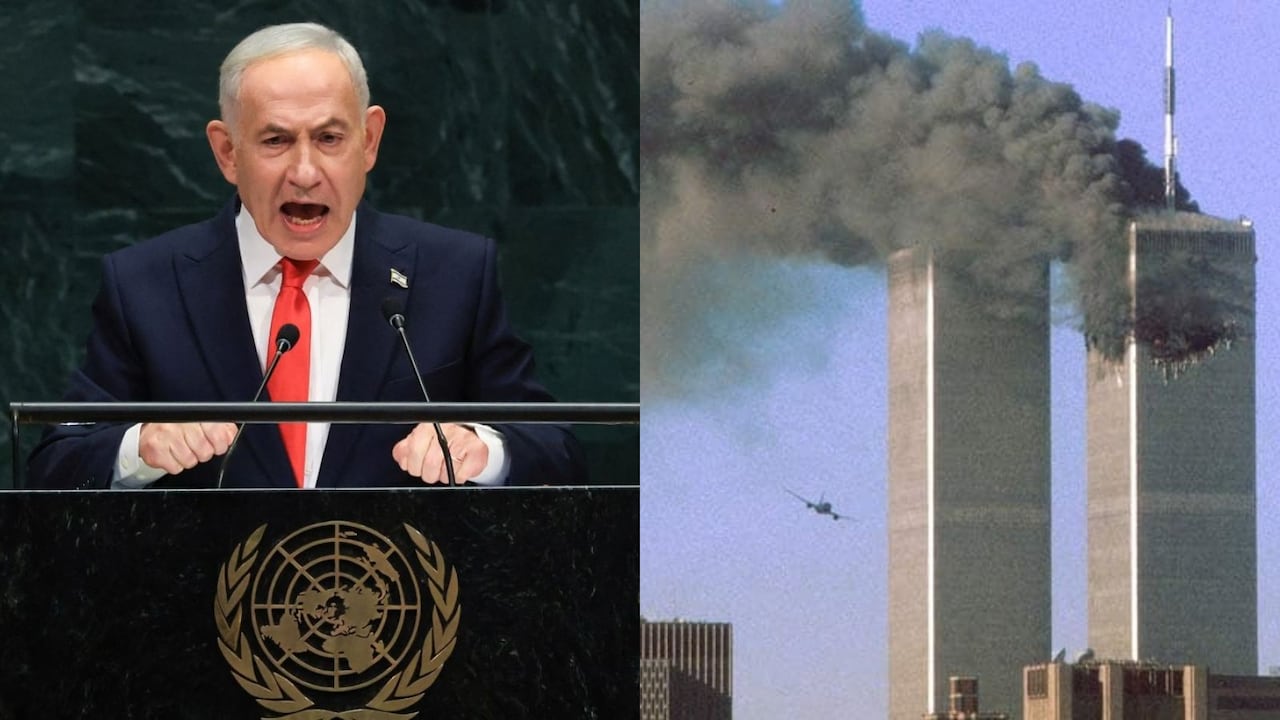
Numbers lose their meaning when they climb into the thousands. You hear about casualties, body counts, and statistics on the evening news, and they tend to blur together into abstract figures. But scale matters when you are trying to understand national trauma. When Israeli Prime Minister Benjamin Netanyahu stood before the United Nations General Assembly, he reached for a specific metric to explain the October 7, 2023, attack to an international audience. He called it the equivalent of sixteen September 11 attacks happening all at once.
That comparison sounds dramatic until you break down the math. Israel is a small country with a population hovering around ten million people. The United States population is well over three hundred million. When roughly 1,200 people are killed in a single day inside a nation the size of Israel, the proportional impact hits entirely differently than it would in a larger superpower. Netanyahu calculated that losing 1,200 citizens out of ten million translates to about 40,000 Americans slaughtered within twenty-four hours. That single statistical conversion drives the core of Israel's current military doctrine.
Critics often miss this psychological math when they evaluate the military campaign that followed. You cannot look at the numbers in a vacuum. To understand why Jerusalem reacted with total war, you have to grasp the sheer proximity of the tragedy. Everyone in Israel knows someone who was killed, kidnapped, or called up to the reserves. It is a society where security isn't some distant geopolitical concept debated in think tanks; it is an immediate, daily reality.
The UN speech wasn't just about proportional arithmetic, though. It served as a lightning rod for global divisions. As Netanyahu took the rostrum, diplomats walked out of the assembly hall in a coordinated protest. He labeled those who left as moral cowards, arguing that Israel is fighting a proxy war for the very nations whose delegates turned their backs on him. Meanwhile, supporters in the gallery chanted in Hebrew, pushing back against the diplomatic isolation.
Accusations of genocide have dominated international courts and diplomatic circles ever since the offensive began. Netanyahu dismissed those claims as the biggest lie of the century, defending the military strategy as an existential necessity. He pointed to ongoing threats from Iran and regional proxies, framing the entire campaign as an unavoidable defense of Western civilization against radical expansionism.
At the same time, the domestic and international pressure doesn't stop at Gaza's borders. The West Bank remains a flashpoint, with rising tensions surrounding settler violence. Netanyahu attempted to distance his government from extremist elements during his address, characterizing rogue actors as isolated juvenile delinquents rather than state-backed policy. Yet, human rights organizations and foreign allies remain deeply skeptical of those distinctions, pointing to a widening gap between official rhetoric and ground-level enforcement.
The debate over proportionality, civilian casualties, and international law will define this era of Middle Eastern history for decades. Whether you view Israel's response as a justified defense of a traumatized nation or a disproportionate catastrophe, the framing matters. Netanyahu wants the world to look at the map through the lens of population size and existential survival. Until global institutions and domestic critics find common ground on what legitimate self-defense looks like under asymmetric warfare, the diplomatic deadlock will only deepen.