Some art collections hide away for half a century, guarded so tightly that even top historians forget what they look like. That silence ends right now.
Sotheby's just secured the legendary Blaquier-Arrieta collection, a twelve-piece marvel of Impressionist and Modern masterworks expected to fetch around $450 million in New York this November. If you thought the high-end art market was running out of steam, think again. This group of paintings brings works by Vincent van Gogh, Paul Cézanne, Claude Monet, Edgar Degas, and Pierre-Auguste Renoir back into the spotlight after being locked away from public view for decades.
The Mystery Behind the Blaquier Collection
Assembled largely in London during the 1970s by Carlos Pedro Blaquier and Nelly Blaquier de Arrieta, this trove remained intensely private. Former Sotheby's auctioneer Philip Hook called it "the stuff of legend" precisely because the family refused to loan out the works for public exhibitions. No one really knew what was inside until now.
When private owners keep museum-quality art locked behind closed doors, they create an invisible vacuum in art history. Scholars talk about these pieces in whispers, relying on old black-and-white photographs from decades-old catalogues. Seeing them in person today feels like unearthing a time capsule.
The Crown Jewels Leading the Sale
The sheer gravity of the artists involved explains the staggering $450 million price tag. Two paintings, in particular, are driving the frenzy.
First is Cézanne's Harlequin, a magnificent oil painting where the artist captured a subject that later inspired pioneers like Pablo Picasso well into the 20th century. The other three versions of this specific subject live permanently in global museum collections, making this upcoming lot the only example left in private hands. Sotheby's expects it to smash previous records for the artist.
Then you have Vincent van Gogh's Chestnut Trees in Blossom, valued at roughly $180 million. Van Gogh painted this masterpiece late in his life at Auvers-sur-Oise, just three months before his premature death, following his discharge from a psychiatric hospital in Saint-Rémy-de-Provence. Helena Newman, chairwoman of Sotheby's European division, points out that the canvas radiates an astonishing amount of positivity and vitality despite the tragedy that loomed just around the corner.
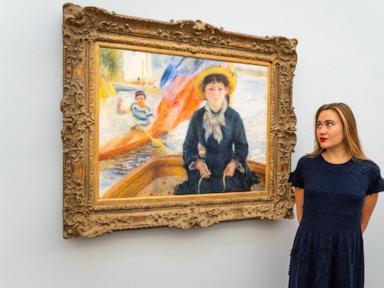
Claude Monet and Camille Pissarro's Parisian cityscapes, alongside Edgar Degas's horse-racing imagery and Renoir's boating scenes, round out the rest of the twelve-piece lineup.
Why Buyers Are Piling Into Masterworks Now
Macroeconomic uncertainty usually makes investors run for the hills, but the ultra-wealthy treat blue-chip art differently. When global geopolitics get messy, capital flees toward assets that have survived centuries of turbulence.
Why risk cash on volatile tech stocks or speculative digital tokens when you can own a piece of cultural history that everyone agrees is unquestionably great? Helena Newman notes that buyers—ranging from American tech billionaires to heavily funded Middle Eastern institutions—are gravitating back to tried-and-tested blue-chip masterpieces.
This isn't just about buying a pretty picture to hang above a penthouse sofa. It is about locking down rare, irreplaceable cultural capital before it disappears back into a private vault for another fifty years.
Set your alarms for November 18 in New York. Watch the bidding wars unfold, and see which billionaire walks away with history.